

Frankincense & Myrrh Benefits for Skin, ancient History & Modern Science (2026)
How two sacred resins walked from the temples of Egypt into a modern regenerating face oil, and why they work better together than apart.
Two Resins, One Ritual: What Frankincense and Myrrh Actually Are
Both frankincense and myrrh begin the same way. A tree is carefully wounded. The tree responds by weeping a thick, aromatic sap that slowly hardens in the sun into golden or reddish-brown tears. These tears are the resin. They are not oil, not essential oil, not extract. They are the raw, unaltered protective substance the tree produces to heal itself.
Frankincense is harvested from trees in the Boswellia genus, most notably Boswellia sacra, Boswellia carterii, and Boswellia serrata. These trees grow on the limestone cliffs and dry soils of Oman, Yemen, Somalia, and India. The English word "frankincense" comes from the Old French franc encens, meaning "pure incense." In Arabic it is called luban. In Hebrew, levonah. In ancient Egypt, it was so valuable that expeditions were sent to the Land of Punt specifically to bring it back.
Myrrh comes from trees in the Commiphora genus, chiefly Commiphora myrrha. These small, thorny trees grow in the same dry regions of the Arabian Peninsula and the Horn of Africa. The name comes from the Semitic root mur, meaning "bitter," a reference to its taste. In Arabic it is murr. The resin is darker, redder, and more astringent than frankincense, with a deeper, more earthy aroma.
This is the first thing almost everyone gets wrong about these two ingredients. The active compounds that skin cares about are not in the scent. They are in the resin itself.
Frankincense in the Bible, the Quran, and Ancient Egypt
Frankincense appears in the Hebrew Bible more than 20 times, always in a context of honor, sacred offering, or healing. In the Book of Exodus, God gives Moses the recipe for the holy incense of the Tabernacle, and frankincense is the final, most precious ingredient: "Take sweet spices, stacte and onycha and galbanum, and pure frankincense with these sweet spices; there shall be equal amounts of each" (Exodus 30:34). Pure frankincense was also laid on the grain offerings in the Temple (Leviticus 2:1, Leviticus 24:7) and stored in the chambers of the priests (Nehemiah 13:9, 1 Chronicles 9:29).
In the Song of Solomon, frankincense is pictured as a scent of love and longing: "Who is this coming up from the wilderness, perfumed with myrrh and frankincense, with every powder of the merchant?" (Song of Solomon 3:6). The prophet Isaiah saw a future in which nations from distant shores would bring "gold and frankincense, and shall proclaim the praises of the Lord" (Isaiah 60:6), a verse later echoed in the New Testament when the Magi brought gifts to the child Jesus: "They presented to him gifts: gold, frankincense, and myrrh" (Matthew 2:11). The Biblical Archaeology Society notes that these three items were standard gifts to honor a king or deity in the ancient world, and the same combination appears in an inscription from King Seleucus II Callinicus offering gifts to the god Apollo in 243 BCE.
In Islam, frankincense is known as luban and has deep roots in the tradition of Tibb an-Nabawi, the prophetic medicine. According to SeekersGuidance, Ibn al-Qayyim in his classical text Zad al-Ma'ad discusses frankincense in a section on remedies, noting that the companion Ali ibn Abi Talib recommended it to a man who complained of forgetfulness. The physician Ibn Sina (Avicenna), whose Canon of Medicine shaped European medicine for 600 years, wrote extensively about frankincense as a drying, warming, and astringent remedy that helps heal wounds, strengthen the stomach, and clear the mind. In Oman and Yemen, where the best Boswellia sacra trees grow, frankincense has been burned daily in homes for generations, a practice that predates Islam and continues today.
Myrrh in the Bible, the Quran, and Ancient Egypt
Myrrh is mentioned in the Hebrew Bible at least 17 times. It was a principal ingredient of the holy anointing oil God commanded Moses to make: "Take fine spices: of liquid myrrh, five hundred shekels" (Exodus 30:23). In the Book of Esther, young women entering the court of King Ahasuerus underwent six months of purification "with oil of myrrh" before meeting the king (Esther 2:12), one of the earliest recorded skincare rituals in history. This is why pure, cold-pressed plant oils were the foundation of every serious beauty regimen in the ancient Near East, and it is why the skin benefits of Moringa seed oil, known in ancient Egypt as ben oil, have been valued for thousands of years.
The Song of Solomon is soaked in myrrh. "A bundle of myrrh is my beloved to me, that lies all night between my breasts" (Song of Solomon 1:13). "I have perfumed my bed with myrrh, aloes, and cinnamon" (Proverbs 7:17). In Psalm 45, the royal bride's garments "smell of myrrh, and aloes, and cassia" (Psalm 45:8). The plant was the scent of romance, royalty, and consecration.
In the New Testament, myrrh arrives with the Magi as one of the three gifts to the infant Jesus (Matthew 2:11). It returns at the end of his life: at the crucifixion he is offered "wine mingled with myrrh" (Mark 15:23), and after his death, Nicodemus brings "a mixture of myrrh and aloes, about a hundred pounds' weight" to prepare his body for burial (John 19:39). Myrrh, in biblical symbolism, marks both the beginning and the end of a life considered sacred.
In Islam, myrrh is murr. A hadith recorded in the collection Kanz-ul-Ummal, narrated by Abu Nuaim, attributes to the Prophet Muhammad the instruction: "Fumigate your houses with mugwort, myrrh, and thyme" (documented in the Wikipedia entry for Myrrh, citing the Encyclopedia of Islamic Herbal Medicine). Ibn Sina classified myrrh as warming and drying in the second degree, noting that when mixed with other oils it helped heal wounds, strengthen hair, and remove scars. He also described its smoke as similar to frankincense but more penetrating.
Why Ancient Cultures Always Used Them Together
In the Bible, they appear in the same verses. In Egypt, they were traded together on the caravan routes from Punt. In Ayurveda, frankincense (called shallaki) and myrrh (called guggulu) are often prescribed together for joint and skin complaints. And in Traditional Chinese Medicine, the pairing is so established it has a name.
The same review cites the ancient Egyptian Papyrus Ebers, which records frankincense and myrrh together in a prescription for treating wounds and skin ulcers. That document is roughly 3,500 years old. The combination has survived every civilization that encountered it, which is what first made modern scientists take the pairing seriously.
That is more than three thousand years of consistent traditional use across the Mediterranean, the Middle East, India, and China. No modern serum can claim a track record anywhere close to that.
The Modern Science of Frankincense and Myrrh Benefits for Skin
Modern research has begun to explain what ancient formulators already knew. Both resins contain rare, skin-supportive compounds that are not found anywhere else in the plant world.
Frankincense for Skin: The Boswellic Acid Story Lab & In-Vitro
Frankincense resin contains a unique family of triterpenoid compounds called boswellic acids. The most studied is 3-O-acetyl-11-keto-beta-boswellic acid, or AKBA. According to the Molecules review, AKBA has been shown in laboratory studies to regulate the activity of matrix metalloproteinases (MMPs), a group of enzymes that break down collagen in the skin (Cao et al., 2019). When MMP activity is calmed, the skin's existing collagen has a better chance of staying intact.
A 2017 laboratory study on human dermal fibroblasts found that frankincense essential oil influenced multiple protein markers involved in skin inflammation and tissue remodeling, and the researchers called for further study of its mechanisms. A separate review published in the Journal of Traditional and Complementary Medicine reported that topical frankincense preparations helped reduce visible redness and support a more even-looking skin tone.
Myrrh for Skin: The Furanoeudesma Story Lab & In-Vitro
Myrrh resin contains a different rare compound called furanoeudesma-1,3-diene, along with curzerene and other sesquiterpenes. These compounds give myrrh its traditional reputation for calming skin and supporting the repair of small wounds. According to the same Molecules review, myrrh compounds have demonstrated anti-inflammatory activity in multiple in-vitro and animal models, and myrrh and frankincense together were specifically documented in the Papyrus Ebers as a treatment for skin ulcers.
An article published by Medisearch, authored by a biomedical science student at the University of Westminster, summarizes that skin health benefits from using frankincense and myrrh include enhanced transdermal absorption, increased skin blood flow, and demonstrated anti-photoaging effects in preliminary studies, while noting that more research is still needed to fully characterize these benefits.
Again, this is preliminary and traditional evidence, not proof of human clinical outcomes. But it aligns with thousands of years of practice across multiple civilizations, which is the kind of convergence serious formulators pay attention to.
The Synergy: Why the Duo Outperforms Either One Alone
The Molecules review (Cao et al., 2019) states directly that the combination of frankincense and myrrh has a better therapeutic effect on certain conditions than either drug alone, and this is why the pair has been used as a single prescription in Traditional Chinese Medicine for over a thousand years. The two resins contain complementary compounds. Frankincense brings boswellic acids and a strong anti-inflammatory signal. Myrrh brings furanoeudesma compounds, a deeper antimicrobial profile, and better skin penetration.
This is the formulator's secret. When you combine these two resins in the right proportions, you do not get twice the benefit. You get something more than that. And when you add carrier oils that the skin recognizes as food, the synergy deepens further.
Essential Oil vs. Real Resin: Why Most Skincare Gets This Wrong
This is the part of the story almost no skincare brand talks about, because it exposes how most "frankincense" and "myrrh" products are built.
Walk into any natural skincare aisle and you will find products listing frankincense or myrrh essential oil on the label. These are made by steam-distilling the resin, a process that captures the volatile, aromatic molecules (the ones that evaporate) but leaves the heavier, resin-based compounds behind. The resulting oil smells wonderful. It carries the aromatherapy benefits. But it contains very little of the boswellic acids and almost none of the heavier repair-supporting compounds that live in the whole resin.
In other words, when a face oil lists "frankincense essential oil" as the 15th ingredient, what you are buying is mostly scent.
| Feature | Essential Oil | Real Resin Infusion |
|---|---|---|
| Process | Steam distillation, high heat | Whole resin soaked in carrier oil for weeks |
| What it captures | Light, volatile, aromatic molecules | Heavy resin compounds including boswellic acids |
| What it loses | Most of the repair-supporting compounds | Nothing, the whole resin stays in play |
| Time to produce | Hours | 30 days or more |
| Best use | Aromatherapy, scent, diffusers | Skin treatment, barrier support, regeneration |
There is a second way to work with these resins, and it is much older. It is called infusion. The whole resin is placed into a plant-based carrier oil and left to sit, undisturbed, for weeks. Slowly, the oil draws out the resin's heavier compounds, including the molecules that steam distillation leaves behind. The oil takes on the color, the density, and the fingerprint of the resin itself. Nothing is thrown away. Nothing is fragmented.
This is the method every ancient culture used, because it was the only method available. It is also the method that preserves the most complete expression of what the resin actually is.
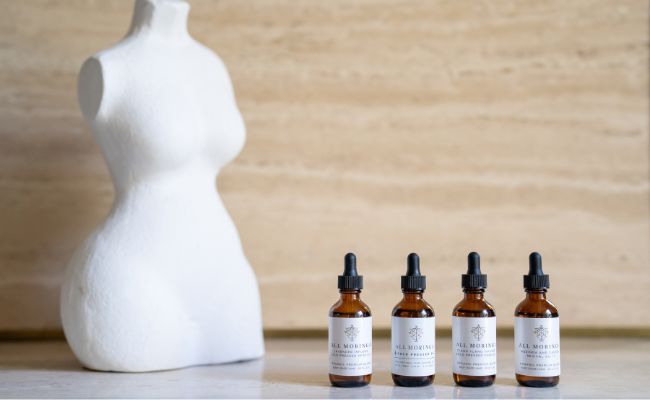
The catch is that infusion is slow, labor-intensive, and expensive. Most modern brands do not do it. We do, in both our Moringa and Frankincense Regenerating Treatment Oil and our Moringa Leaf and Seed Synergy Oil, where whole plant material is slow-infused into cold-pressed Moringa seed oil for weeks.
How We Crafted Our Moringa and Frankincense Regenerating Treatment Oil
When we decided to honor this ancient duo in a modern face oil, we made a decision that shaped every step of the process: we would not take the shortcut. We would use real frankincense resin, not just essential oil, and we would infuse it the traditional way, slowly, into an oil base the skin recognizes.
A 30-Day Frankincense Resin Infusion
The foundation of the oil is a 30-day frankincense resin infusion. Real organic frankincense resin is placed into a carefully chosen base of organic Moringa seed oil and organic castor oil, and left to infuse for a full month. Over those 30 days, the heavier resin compounds gradually dissolve into the oil, creating a deeply saturated base that carries the full fingerprint of the resin, not just its scent.
This infusion is the foundation of the formula, not an afterthought. Most face oils with "frankincense" on the label add one drop of essential oil at the end of production. Ours starts with weeks of patient infusion, and every later ingredient is added on top of that base.
Why Moringa Seed Oil and Castor Oil as the Base
The choice of base matters. Moringa seed oil is unusually high in oleic acid and behenic acid, two fatty acids that the human skin barrier recognizes and uses. Oleic acid supports suppleness. Behenic acid is rare in plant oils and adds long-term stability. Moringa seed oil has been used on skin for thousands of years across Africa and South Asia, which is why the ancient Egyptians called it ben oil.
Castor oil, rich in ricinoleic acid, is a traditional carrier with a long history in skincare across Ayurveda, traditional Mediterranean practice, and Ibn Sina's Canon of Medicine. Together, the two oils create a base that is lipid-rich, skin-recognizable, and deeply protective.
In other words: we chose two oils the body already understands as food, and we let the resin release its character into them, slowly.
Three Organic CO₂ Extracts to Deepen the Formula
After the infusion is complete and the base is clarified, we elevate the treatment with three supercritical CO₂ extracts. CO₂ extraction uses pressurized carbon dioxide instead of heat or solvents, which means delicate compounds survive the process intact.
| CO₂ Extract | Rare Compound | What It Brings |
|---|---|---|
| Myrrh CO₂ | Furanoeudesma-1,3-diene | Anchors myrrh's traditional reputation for calming and repair |
| Pomegranate Seed CO₂ | Punicic acid (omega-5) | Almost exclusive to pomegranate seed, studied for skin regeneration and elasticity |
| Sea Buckthorn Berry CO₂ | Palmitoleic acid (omega-7) + carotenoids | Supports skin renewal and a healthy-looking radiance |
Every one of these ingredients was chosen because it brings a specific, rare compound that the base oils do not. Nothing is there for marketing. Nothing is filler.
A Finished Formula With Seven Ingredients
This is what we mean by simplicity as proof of integrity. When a formula is built from real, whole-plant materials, it does not need to hide behind a long ingredient deck.
Who This Oil Is For
This is a regenerative treatment oil, which is a different category from a standard face oil. It is designed to support the skin's own repair processes over time, not to force rapid surface change with aggressive actives. It is most useful for:
✓ Dull, tired, or environmentally stressed skin
✓ Loss of firmness or elasticity
✓ Dry or depleted skin that struggles with barrier recovery
✓ Skin overworked by strong actives, acids, or retinoids
✓ Early visible signs of skin aging
✓ Anyone who wants a formula rooted in real whole-plant ingredients, not synthetic lab actives
It is not a quick fix. It is a slow, steady companion for people who understand that skin heals on its own schedule when it is given what it needs. If you are building a complete natural ritual, you can explore our full Moringa skincare collection for cleansers, creams, and oils designed to work together.
Apply 2 to 4 drops to clean, slightly damp skin, morning or evening, or both. Warm the drops between the palms, then press gently into the face and neck. The natural resin aroma is part of the experience and softens as the oil absorbs.
Frequently Asked Questions
A Final Thought
Every culture that ever wrote down how to care for skin eventually wrote down these two resins. The Hebrew prophets, the Egyptian embalmers, the Magi, the companions of the Prophet Muhammad, the physicians of the Tang dynasty, Ibn Sina in his Canon of Medicine: all of them reached for the same two trees. That is not a coincidence. It is the longest running natural skincare tradition in human history, and the verdict has been remarkably consistent for more than 5,000 years.
What we did, with our Moringa and Frankincense Regenerating Treatment Oil, was simply honor the method. Real resin, slow infusion, skin-recognizable base oils, and three rare CO₂ extracts that add what the base cannot. Seven ingredients. No shortcuts. No synthetic fragrance. Just the duo the ancient world trusted most, delivered the way it was always meant to be used.
If your skin is tired, stressed, or asking for something deeper than a surface treatment, this is the oil we made for you.
Bring the Ancient Duo Home
Real frankincense resin. Slow 30-day infusion. Organic Moringa seed oil base. Three rare CO₂ extracts. Seven ingredients total. The way these resins were always meant to be used.
With care,
Tzvi and the All Moringa Family

*This statement has not been evaluated by the Food and Drug Administration. This product is not intended to diagnose, treat, cure, or prevent any disease.
Leave a comment
This site is protected by hCaptcha and the hCaptcha Privacy Policy and Terms of Service apply.