


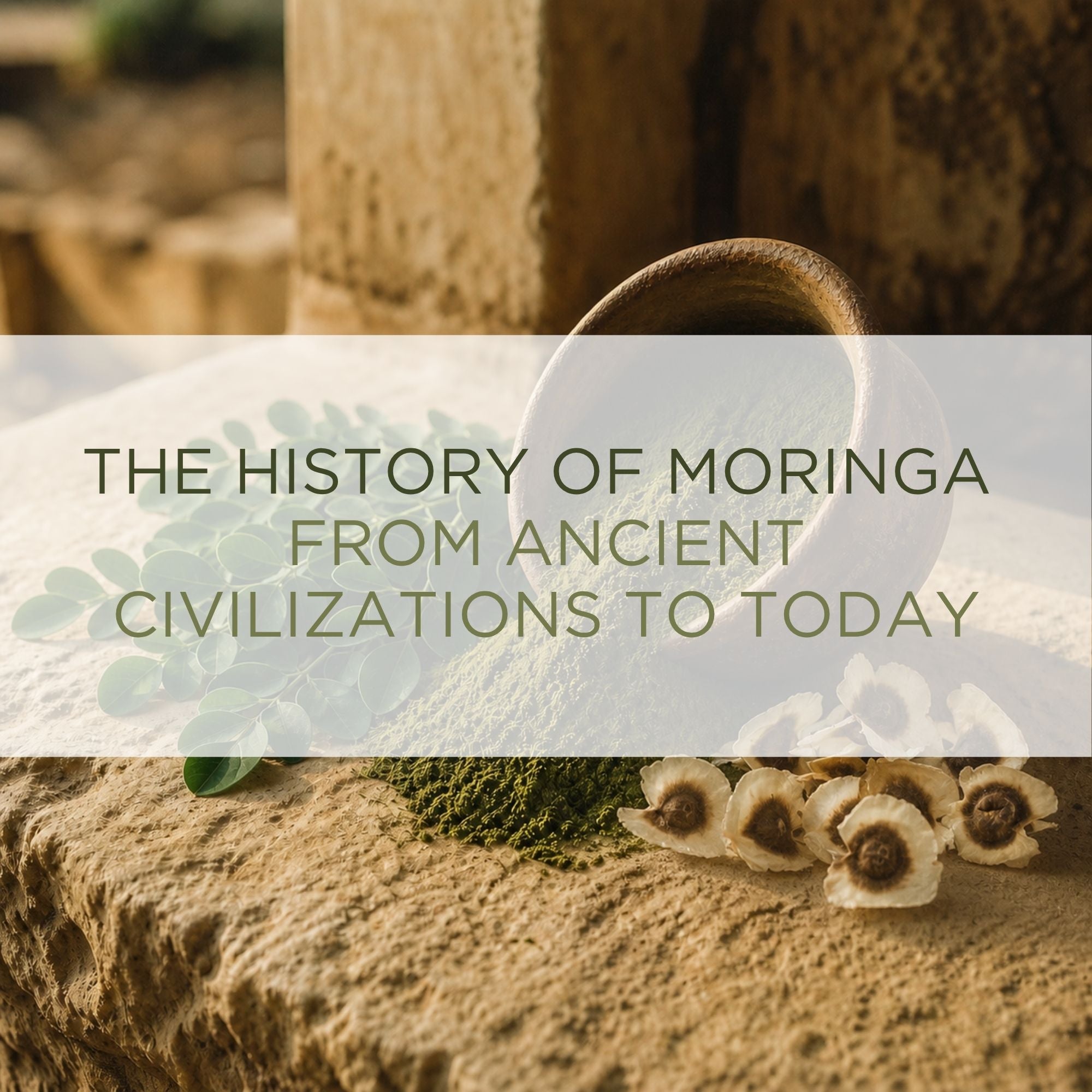
The History & Origins of Moringa: 4,000 Years Across Ancient Civilizations
The Tree That Outlasted
Every Empire
Three thousand years ago, when archaeologists opened the tomb of Maya, an Egyptian Treasury official buried during the reign of Tutankhamun, they found ten sealed jars inside.
The jars contained moringa oil.
That is not a marketing story. It is an archaeological record. And it is one chapter in a history that spans four millennia, six civilizations, and every continent where human beings have ever needed to feed themselves or heal.
If you are reading this because you recently discovered moringa, you arrived late. The ancient world got there first. But the tree is still here. And what it offered the Mauryan Empire, ancient Egypt, and sub-Saharan Africa, it still offers today.
This is the complete history of Moringa oleifera, from its origins in the foothills of the Himalayas to the jar of moringa powder sitting on a kitchen counter in 2026.
• Moringa has 4,000+ years of documented human use, from Ayurvedic India to the Caribbean
• Moringa oil was found in the sealed Tomb of Maya, Treasury official under Tutankhamun (~1300 BCE)
• Documented by Pliny the Elder in Naturalis Historia, Rome, 77 CE
• Sub-Saharan African communities adopted moringa independently of Indian and Mediterranean traditions
• In 2025, Australia classified it as a "novel food" -- a regulatory gap, not a safety finding
• Moringa is fully legal in the US, UK, EU, and most of the world
Where Did Moringa Originally Come From?
The species is native to that region and entered human use at least 4,000 years ago, based on documentation in Ayurvedic Sanskrit texts (Ayurvedic literature, traditional use record). From that single origin point, it traveled further than almost any other food plant in history — a domestication story documented by researchers at the USC Plants and People project.
The moringa tree is unusually generous by design. Nearly every part of it is useful. The leaves are nutritionally dense, containing protein, vitamins, and minerals in a whole-food form. The seeds yield a stable oil that resists rancidity in heat. The pods and flowers are edible. A community that discovers this tree tends to keep it.

From its northern Indian origin, moringa moved west into Egypt and the Middle East through trade routes active since at least 2000 BCE. It spread north into the Mediterranean world through Egyptian and Phoenician commercial networks. It moved south and west into Africa through independent discovery and later trade contact. By the 17th century, colonial and trading networks had carried it across the Atlantic into the Caribbean. At each stop, a different culture found the same tree and arrived at similar conclusions about its value.
What Role Did Moringa Play in Ancient India?
In Ayurvedic practice, moringa leaves were used as a nutritional food source and incorporated into preparations intended to support energy and general health. The tradition recognized different parts of the plant -- leaf, seed, root, and bark -- as useful in different ways, reflecting a whole-plant understanding that modern nutritional science confirms is well-founded. According to USDA FoodData Central, dried moringa leaf powder contains iron, calcium, potassium, vitamin A, vitamin C, and all nine essential amino acids.
Traditional Use -- Mauryan Empire (322-185 BCE)
How Did Ancient Egypt Use Moringa?
The Tomb of Maya -- Archaeological Record
Egyptian cosmetic texts document moringa oil in preparations used to protect and moisturize skin against desert conditions. It was combined with castor and sesame oils and applied as a practical form of skin care in a climate that demanded it (traditional use, historical record). Egyptian physicians also recorded moringa oil in medical papyri alongside other plant-based preparations.
Moringa seed oil's stability explains its appeal. It contains high concentrations of oleic acid, behenic acid, and vitamin E (INCI/CosIng ingredient database, seed oil composition). These qualities make it stable in heat, compatible with skin, and resistant to rancidity without refrigeration. In a desert civilization before modern preservation, those properties were genuinely valuable.
How Did Greece and Rome Use Moringa?
By approximately 2000 BCE, moringa oil had reached the Mediterranean through Egyptian and Phoenician trade networks. What is notable about moringa's adoption in Greece and Rome is how ordinary it was. Neither civilization treated it as an exotic novelty. It appeared in everyday products alongside long-established ingredients.
Pliny the Elder, Naturalis Historia (77 CE)
The Mediterranean world understood moringa as a reliable, multi-purpose resource. As the Roman Empire expanded through the first through fourth centuries CE, moringa moved with Roman trade networks across Europe, North Africa, and the Middle East. By the time Rome declined, the plant had been woven into Mediterranean life for centuries.
How Did Sub-Saharan Africa Embrace Moringa?
Africa represents one of the most significant chapters in moringa's history, and one of the least told in Western wellness media. Communities across the Sahel, West Africa, and East Africa developed a deep relationship with moringa largely independent of the Indian and Mediterranean traditions, arriving at similar conclusions through direct experience (traditional use, ethnobotanical documentation across sub-Saharan Africa).
Across the Sahel, moringa leaves became a critical food source during dry seasons when other fresh produce was unavailable. Communities harvested, dried, and stored the leaves as a nutrition reserve, and used the pods and seeds as additional food sources. In regions facing periodic food scarcity, the moringa tree's ability to grow in poor soil with minimal water while producing nutritious leaves year-round made it genuinely irreplaceable.
Nutritional Density Government Data
The fact that sub-Saharan communities adopted moringa independently of South Asian and Mediterranean traditions says something important: this was not a plant that spread through cultural influence or borrowed knowledge. Multiple civilizations, separated by thousands of miles, found the same tree and recognized the same value. That pattern of independent recognition is rare in botanical history, and documented in academic literature on Moringa's traditional uses across cultures.
How Did Moringa Spread to the Caribbean and Latin America?
In 1817, when Jamaica was still a British colony, moringa was formally presented to the Jamaican Chamber of Commerce as a valuable food and culinary ingredient (historical record, 1817 Jamaican Chamber of Commerce presentation). British colonial networks had carried the tree from India and Africa into the Caribbean, where it adapted readily to the tropical climate. From Jamaica, moringa spread through the Caribbean and into Central and South America.
Moringa in the Caribbean and Latin America Today
What Happened to Moringa in the 20th Century?
For much of the 20th century, moringa was largely invisible to Western markets despite being consumed daily across South Asia, East Africa, the Caribbean, and Central America. The gap was not in the plant. It was in the markets.
That began to shift in the 1990s, when nutritional researchers and humanitarian organizations started documenting moringa's potential as a food security resource in regions facing malnutrition. The World Health Organization and various development agencies noted the leaf's nutritional density and supported its use in supplementation programs. The term "Miracle Tree" gained renewed attention, not from marketing, but from field workers observing what communities had known for centuries.
As global wellness interest in plant-based nutrition grew through the 2010s, moringa arrived in Western markets as a supplement and superfood ingredient. For most Western consumers, it felt like a discovery. For the communities in India, Africa, and the Caribbean who had been eating it for generations, it was simply Tuesday.
Why Did a 4,000-Year-Old Plant Get Called "Novel" in 2025?
Under Australian food law, any food not explicitly approved on its positive list is prohibited. "Novel food" applies to any food not widely consumed in Australia before May 1999. Moringa was not part of mainstream Australian food culture by that date. When a formal application arrived to approve it, the safety data submitted was insufficient to complete the regulatory assessment. FSANZ rejected it. Moringa food imports are now turned away at the Australian border.
The irony is precise. A plant documented in the tomb of an Egyptian official, carried by Roman soldiers across three continents, and consumed daily by hundreds of millions of people, is still waiting on a regulatory approval stamp in one country. That stamp says nothing about the tree. It says something about how slowly administrative frameworks catch up to what the rest of the world already knows.
Moringa is fully legal and freely available in the United States, the UK, the EU, and most of the world. The Australian situation applies only to Australia and New Zealand and has no effect on US consumers.
What Does All Moringa Have to Do With This History?
We did not invent anything. We kept faith with what was already there.
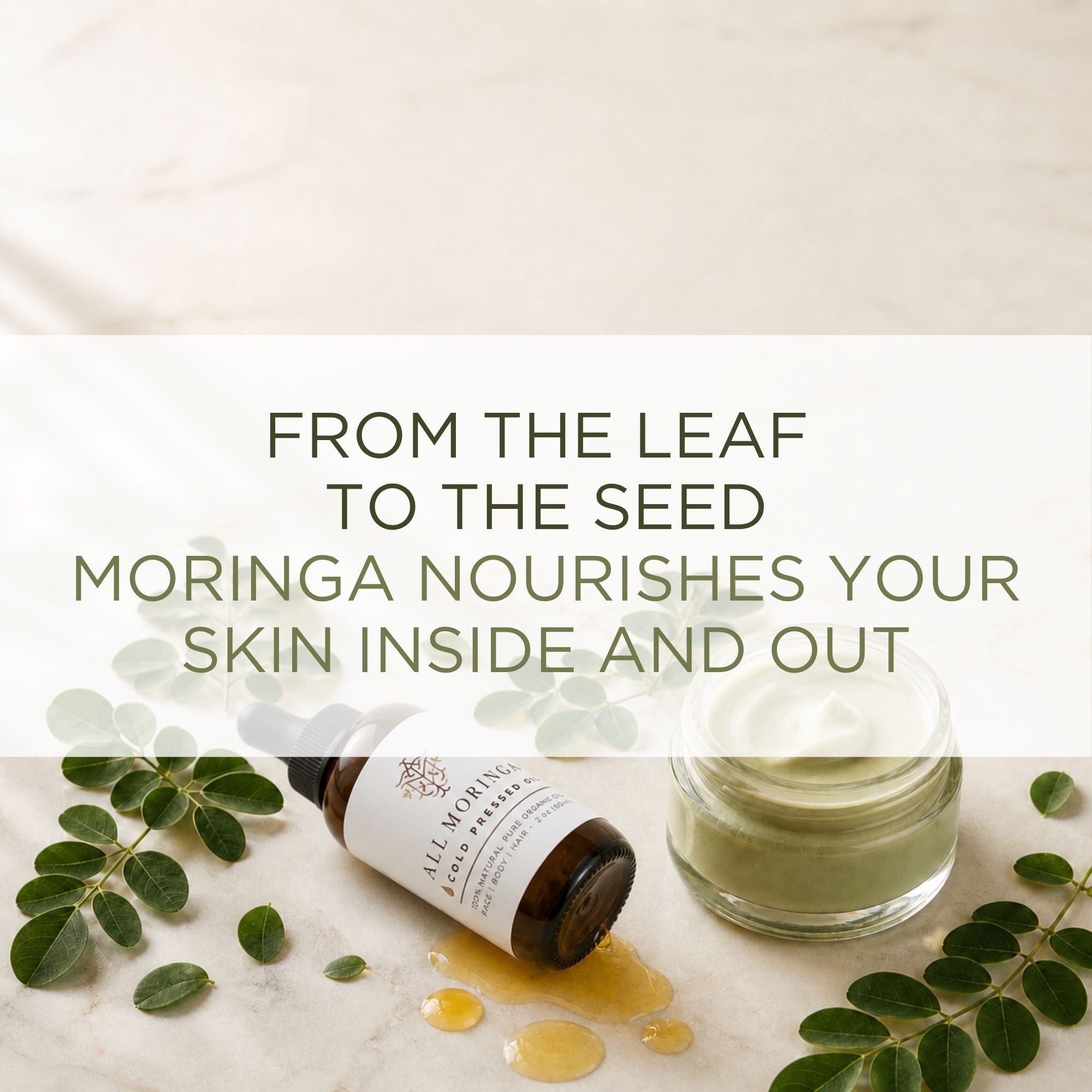
When Tzvi and Maya founded All Moringa in 2019, the reasoning was straightforward: here is a plant with 4,000 years of documented human use, valued by ancient India, Egypt, Rome, Africa, and the Caribbean. It does not need to be engineered, extracted, or combined with twenty other ingredients. The leaf is complete. The seed yields an oil that skin recognizes. One tree, two forms of nourishment.
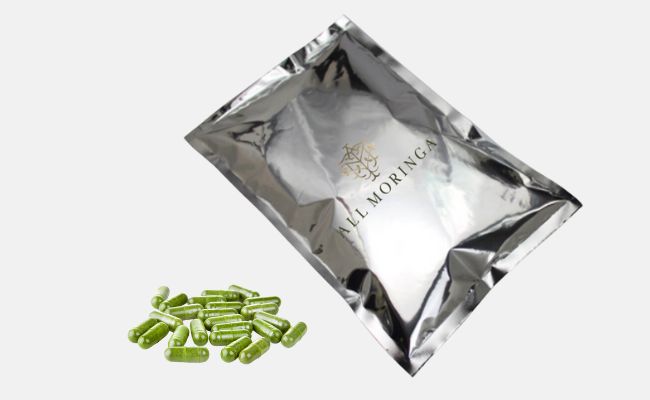
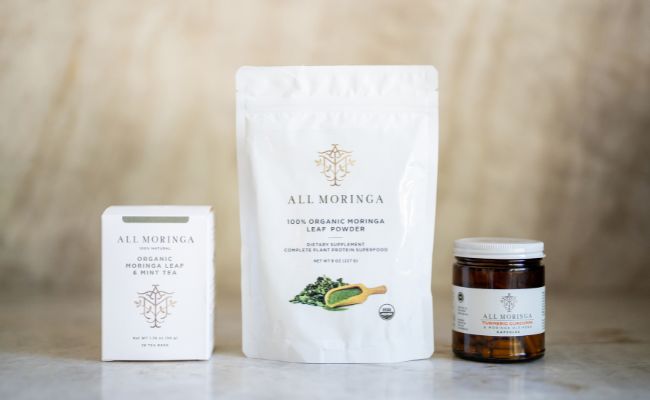
Our Moringa Leaf Powder is the same whole leaf that Ayurvedic practitioners documented and Mauryan soldiers consumed. Whole leaf, minimally processed, nothing removed, nothing added. Your body recognizes it as food because it is food, in the form nature intended. Our Moringa Capsules carry that same leaf in a format that fits any daily routine.
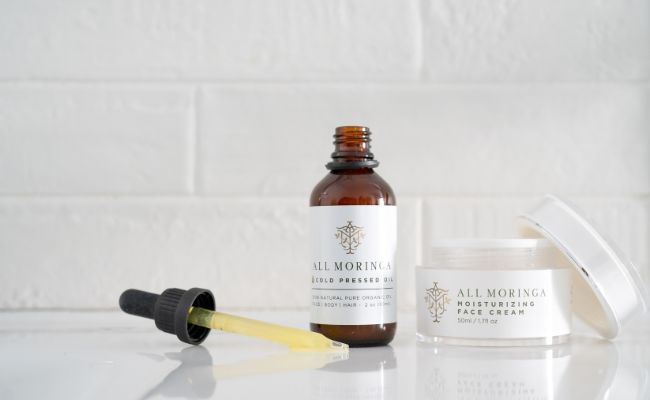
The seed oil in our Pure Moringa Seed Oil is the same oil found in the Tomb of Maya. The same oil Pliny the Elder documented. Pressed cold from the seed, stable in heat, compatible with skin that evolved alongside this plant.
For those who want both in a single formula, our Moringa Leaf and Seed Synergy Oil combines leaf antioxidants with seed lipids in one topical oil. The full plant, for skin that understands both.
Four thousand years is not a marketing claim. It is the record. And every All Moringa product carries it.
Frequently Asked Questions
The Tree That Outlasted Every Empire
The empires that first cultivated moringa are long gone. The Sanskrit scholars who named it "shigru," the Egyptian official whose tomb held ten jars of its oil, the Roman soldiers who carried it across three continents -- all are history.
The tree is still here.
That is not a metaphor. It is what 4,000 years of unbroken human use actually looks like. Not a rediscovery. Not a trend. A continuity.
All Moringa exists inside that continuity. We did not invent a product. We chose a plant that humanity has already chosen, across every civilization that ever encountered it, and committed to offering it in its purest form: whole leaf, whole seed, nothing removed, nothing added.
Start With the Miracle Tree
From whole leaf to seed oil, every All Moringa product carries 4,000 years of human knowledge. No fillers. No additives. Just the plant, the way it has always been.
With care, Tzvi and the All Moringa Family

*This statement has not been evaluated by the Food and Drug Administration. This product is not intended to diagnose, treat, cure, or prevent any disease.
Leave a comment
This site is protected by hCaptcha and the hCaptcha Privacy Policy and Terms of Service apply.