

Moringa vs AG1: Why One Leaf Beats 75 Ingredients

Moringa vs AG1
The Whole Leaf, Not the Long List
AG1 puts more than seventy-five ingredients into one scoop. I built my whole company around one leaf. People tell me that is backwards.
It is not. It is the whole idea.
My name is Tzvi. My wife Maya and I started All Moringa from our kitchen, and I want to make a case I believe completely: a single moringa leaf is a real alternative to a seventy-five-ingredient greens powder, not a lesser one. Not because we found a clever marketing angle, but because of what is actually inside the leaf, and because of what happens to most of those seventy-five ingredients once they are in a tub.
This is an honest comparison, with sources. I will show you what one leaf delivers, why a long ingredient list is not the strength it looks like, and what each one costs per day. Then you decide.
- AG1 blends more than 75 mostly synthetic ingredients into one scoop for $79 to $99 a month.
- One moringa leaf naturally carries vitamins A, C, and E, iron, calcium, potassium, magnesium, all nine essential amino acids, antioxidants, and fiber (USDA FoodData Central), in one whole food.
- More ingredients on a label does not mean more nutrition absorbed; megadosed water-soluble vitamins are largely excreted.
- All Moringa capsules cost about $0.96 a day, roughly a third of AG1's daily cost.
- AG1 adds probiotics and enzymes a leaf does not, but those come from everyday fermented foods.

What is the real difference between moringa and AG1?
One is built in a lab. The other grew on a tree. That is not a poetry line. It changes what your body actually receives.
AG1 was founded in 2010 and costs roughly $79 to $99 a month. Moringa has been eaten as food and used in traditional Ayurvedic wellness for thousands of years, and a jar of our capsules works out to under a dollar a day. The rest of this article is the detail behind those two sentences.
Is moringa really a strong enough alternative to AG1?
Read that list again. Vitamins, minerals, complete protein, antioxidants, rare plant compounds, fiber. That is the entire reason a person buys a greens powder in the first place. Moringa carries it in one ingredient your body has known how to digest for as long as your body has existed.

Nothing here is isolated. Nothing is synthesized in a lab and bolted back together. The nutrients arrive the way the plant grew them, in their natural amounts and in each other's company, which is the form your body evolved to recognize and use. That is not a slogan. It is the difference between eating a food and swallowing a list.
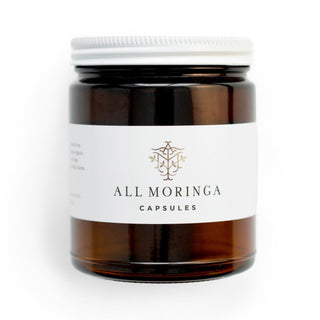
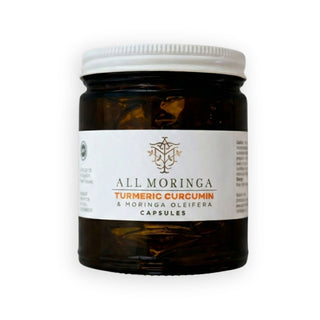
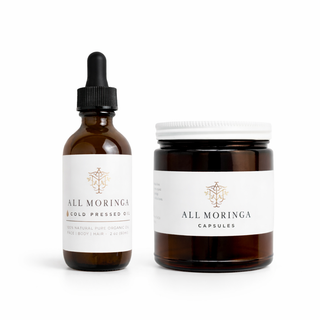
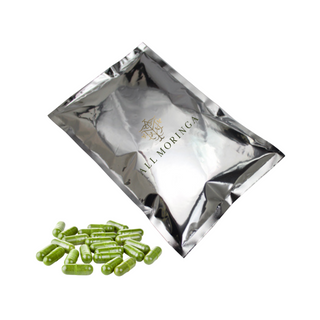
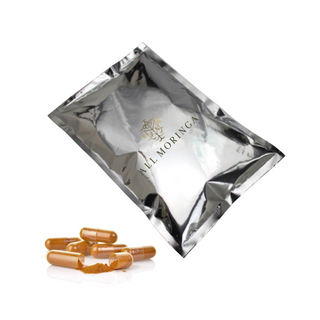
If you want that in the simplest daily form, our Moringa Capsules are exactly this: one ingredient, four capsules a day, nothing else added. New to moringa? Start with two a day to see how you feel, then build up to the recommended four.
Does more ingredients mean more nutrition?
Your body does not absorb a list. It absorbs food, and it can only use so much of certain nutrients at a time. Water-soluble vitamins, like vitamin C and the B vitamins, are not stored by your body in large amounts. When a formula lists one of them at many times the daily value, the impressive number is mostly passing straight through you and out. You are paying for the figure on the label, not absorbing it. That is basic nutritional science, not a conspiracy.
Picture the little scoop they give you to stir into your water each morning. One scoop is the whole daily serving. Now imagine seventy-five or ninety separate ingredients all packed into that single spoonful. There is only so much that fits. What you actually get is a sprinkle of each one, a pinch of this, a dusting of that, almost never enough of any single ingredient to matter. That is the catch a long label hides: the more names they cram into one little spoon, the less of each one is really in there.
Then there is the dilution problem, and you do not have to take my word for it. A dietitian-authored review of AG1 alternatives put it plainly: by including so many ingredients, you risk diluting them, and the goal should be quality over quantity. Many greens powders, AG1 included, group their ingredients into a proprietary blend, which means you are told the total weight of the group but not how much of each single ingredient is in there. So you can read all seventy-five names and still not know whether the one you care about is a real dose or a pinch added so it can be printed on the box. In wellness we have a word for that pinch. We call it fairy dust.
Nothing in a moringa leaf is fairy dust. Nothing is megadosed to look good on a label. Everything is present in the amount a living plant put there, and everything has its place. That is what concentration actually means: not a bigger number, but nothing wasted.

Isn't AG1 basically the same as other greens powders and gummies?
Greens powders, daily gummies, and "foundational" blends like IM8, which is formulated in a lab and markets around ninety ingredients, all work the same way: a long list of isolated, often synthetic ingredients, assembled to claim support for immunity, energy, gut, and half a dozen other pain points at once.
And to make a powder of sixty or eighty isolated ingredients go down easily, the formula usually needs help. That is where the added sugars, natural flavors, gums, and emulsifiers come in, the exact additives a lot of people picked up a greens product to get away from. Gummies are the clearest case: most are held together with added sugar.
Moringa has none of that. No added sugar, no natural flavors, no gums, no emulsifiers, no synthetic vitamins. There is nothing to mask, because it is one real food. The leaf does not need to be made to taste like health. It simply is food.
So when you compare moringa to AG1, you are really comparing it to the whole copy-paste aisle at once. One whole leaf, or seventy-five-plus isolated ingredients with additives to hold them together. That is the choice, no matter whose label is on the tub.

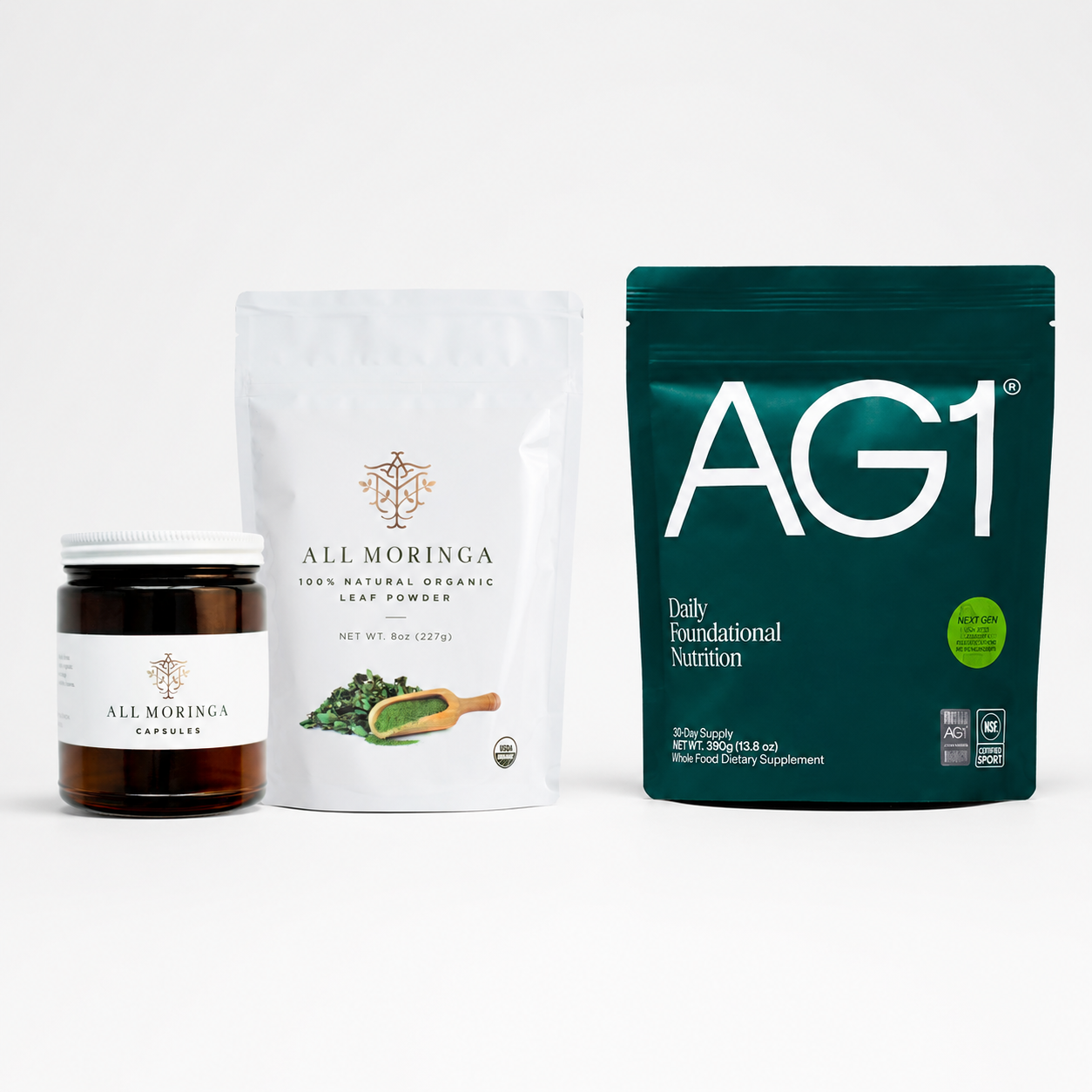
How do moringa and AG1 compare side by side?
Here is the honest head-to-head, kept to the dimensions that change your decision.
| What you are comparing | AG1 (and most greens powders) | All Moringa whole leaf |
|---|---|---|
| Number of ingredients | More than 75 | 1 |
| What it is | A blended formula | A single whole food |
| What is inside | Many isolated and synthetic nutrients | Vitamins A, C, E, iron, calcium, potassium, magnesium, all 9 essential amino acids, antioxidants (quercetin, kaempferol), isothiocyanates, fiber, all naturally |
| How the nutrients arrive | Isolated, recombined, many synthetic | In their natural form and proportion, nothing isolated |
| Dose transparency | Proprietary blends hide per-ingredient amounts | One ingredient, fully transparent |
| Added flavors, gums, sweeteners | Commonly included | None, just leaf |
| Heritage | Founded 2010 | Used for thousands of years (Ayurveda) |
| Whose word you take | Paid experts and athletes | A plant people have trusted for generations |
| Cost per day | About $2.63 to $3.30 | About $0.96 (capsules) |
| Cost per month | $79 to $99 | About $29 (capsules) |
One row is worth saying out loud. At about $0.96 a day for our capsules against AG1's $2.63 to $3.30 a day, the leaf costs roughly a third of the formula. That gap does not buy you less nutrition. It buys you fewer steps, fewer additives, and fewer middlemen between the plant and you.
Is there anything AG1 adds that moringa does not?
But look at what those add-ons actually are. Probiotics come from any fermented food, a spoon of yogurt, a forkful of sauerkraut, a sip of kefir. Enzymes come from eating real, whole foods. You do not need a $99 tub to get them, and you certainly do not need seventy-three other ingredients riding along to deliver two. If a daily probiotic matters to you, add a real fermented food you enjoy. Keep the leaf for the nutrition. You will spend less and eat better.
That is the honest line: moringa is not a pharmacy in a pouch, and it is not trying to be. It is one real food doing the main job a greens powder is bought for, and doing it cleanly.

How much does moringa cost compared to AG1?
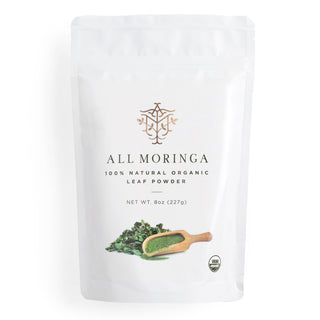
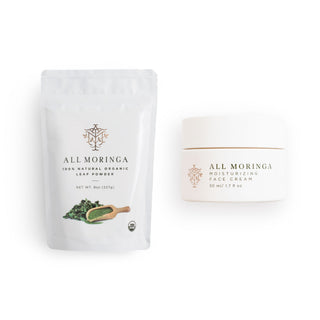
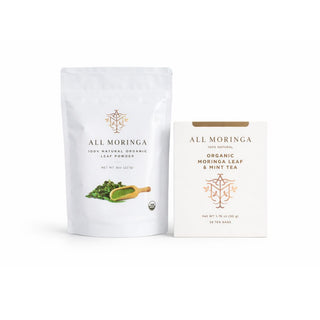
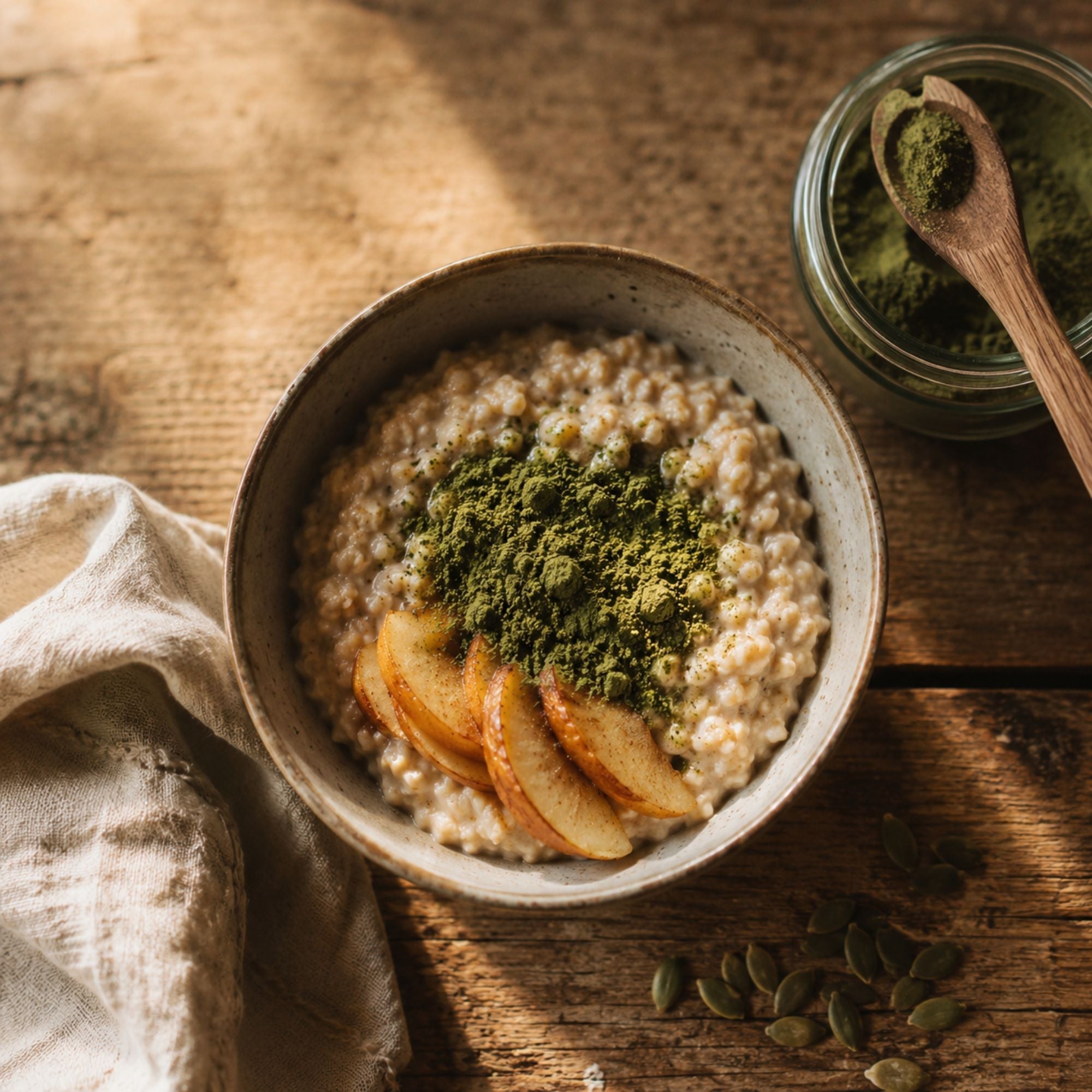
Prefer to stir it into a smoothie or oats? Our Moringa Leaf Powder is the same $28.90 for an eight-ounce bag, which lasts months at a daily teaspoon. It carries a 4.8 star rating across 151 verified customer reviews, it is USDA Certified Organic, and it is grown on a single family farm in India, the original homeland of the tree, then freeze-dried in small batches to protect the nutrients. One ingredient, one farm, one process you can picture. That is the other thing the price gap buys you: simplicity you can actually verify.

Should you switch from AG1 to moringa?

It depends on what drew you to AG1 in the first place.
If what you wanted was real, whole-food nutrition you take every morning, the antioxidants, the vitamins, the minerals, the protein, then moringa gives you that more directly, more naturally, and for about a third of the cost, because it is an actual whole food rather than a blend assembled to resemble one. Make the switch, or run the leaf alongside what you do now and feel the difference for yourself.
If the specific thing you valued was the all-in-one convenience of bundling probiotics and enzymes into the same scoop, and the monthly cost does not bother you, AG1 is built for that. But most people I talk to were never really after seventy-five ingredients. They were after one good daily habit they could trust, and somewhere along the way they were told that trust comes from a longer list. It does not. It comes from knowing exactly what you are taking and why.
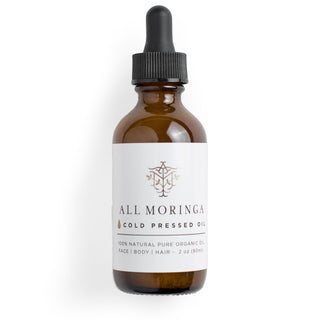
The same tree gives more than nutrition, by the way. Its seeds are cold-pressed into a skin oil, which is why we say one tree, whole-body care, from leaf to seed. But that is another article. If you like honest whole-food comparisons, see our looks at moringa versus matcha and moringa versus berberine.
The bottom line
AG1 builds whole-food nutrition out of more than seventy-five ingredients and asks you to trust the list. Moringa already is whole-food nutrition, concentrated in one leaf your body has recognized for thousands of years, at about a third of the daily cost. More names on a label was never the same thing as more nutrition in you.
I bet a whole company on that leaf. One ingredient. The whole leaf. Everything in its place.
Start where my family did
One leaf, taken every day. The simplest place to begin is a jar of capsules, or the powder if you like to stir it into your morning.
With care,
Tzvi and the All Moringa family
Frequently asked questions

*This statement has not been evaluated by the Food and Drug Administration. This product is not intended to diagnose, treat, cure, or prevent any disease.
Leave a comment
This site is protected by hCaptcha and the hCaptcha Privacy Policy and Terms of Service apply.