

Does Moringa Have Vitamin D, B12 & Other Nutrients? The Complete Facts
Moringa Nutrition
Moringa has no B12 and no vitamin D. Here is what the leaf does give you.
No. Moringa leaf has no vitamin B12 and no vitamin D. The USDA food database lists zero for both. Plants do not make B12. Bacteria do. And leafy greens are not a source of vitamin D. If you eat a plant-based diet, you still need a B12 supplement, whatever a moringa label says.
What the leaf does have is genuinely impressive. Iron, which your body uses to carry oxygen in the blood and to make energy. Four B vitamins (B1, B2, B3 and B6), which help the body turn food into energy. Magnesium, needed for energy, muscles and nerves. Calcium, which builds and maintains bones. Vitamins A, C and E. And a complete plant protein, with all 9 essential amino acids.
That is the difference from a vitamin pill. An iron pill gives you iron. A B6 pill gives you B6, made on its own. The leaf gives you all of the above together, the way the plant grew them, from a plant in which researchers have identified more than 330 compounds (Biomedicines, 2025). One plant, nothing isolated.
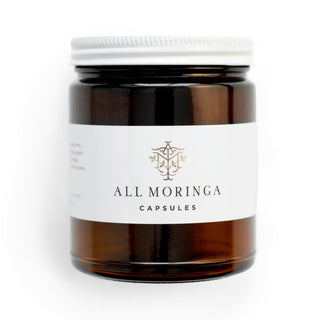
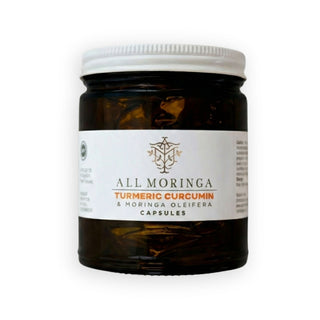
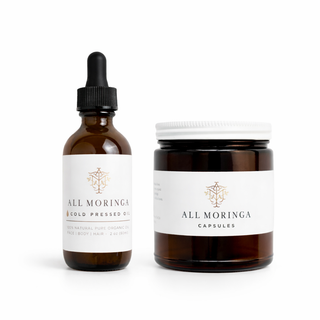
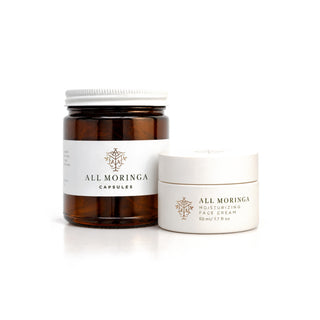
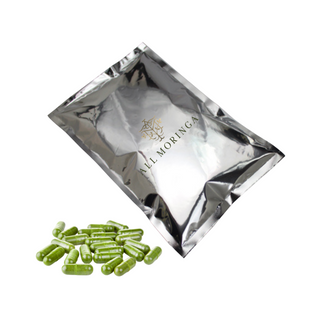
That leaf is what goes into our Organic Moringa Capsules. $28.90 for a month, about 96 cents a day, with a 30-day money-back guarantee.
This page also covers how many nutrients moringa really has, and where the "300 diseases" figure comes from.

Does moringa have vitamin B12?
Vitamin B12 (cobalamin) is produced exclusively by bacteria and archaea, not by plants. Animals accumulate it through their food chain, which is why B12 concentrates in meat, fish, eggs, and dairy. A review by Watanabe F., published in Experimental Biology and Medicine (2007), found that most blue-green algae sold as supplements carry a look-alike form of B12 that does not work in the human body. A few seaweeds, such as nori, are the exception. Leafy plants like moringa are not.
So where does the idea come from? Partly from tables that get copied from one paper to the next. A 2024 review of moringa in the journal Nutrients prints a B12 figure for the plant in a nutrient table. It cites an earlier paper and describes no measurement of its own. The USDA database, the standard reference for what is in food, lists zero. We go with zero.
Some moringa brands use vague energy language that implies a B12-like effect. To be precise: moringa's energy-supportive properties come from its iron content, which supports oxygen transport, and its B vitamins B1, B2, B3, and B6, which support energy metabolism. Those are the real mechanisms, and they are genuinely meaningful. They are not B12.
- Vitamins A, C and E
- B vitamins B1, B2, B3 and B6
- Iron, calcium, potassium, magnesium
- Complete protein, all nine essential amino acids~25 g per 100 g
- Fiber, soluble and insoluble~12 to 20 g per 100 g
- Antioxidant compoundsincl. quercetin · kaempferol · chlorogenic acid
- Isothiocyanatesthe compound family studied in broccoli
What is inside our capsule

| What it is | A daily capsule of moringa leaf. No taste, nothing to mix, ten seconds with a glass of water. |
|---|---|
| How much a day | Two capsules twice a day, with food. That is 2 grams of leaf. A jar lasts about a month. |
| What is in it | Organic moringa leaf, 500 mg a capsule, in a plant-cellulose shell. No seed, no extract, no fillers. |
One of our customers, Sarah W., put it this way: “I've been using moringa for the past 10 years and this brand makes the best quality moringa I've found!”

What moringa leaf does have
USDA FoodData Central lists most of the following nutrients in moringa leaves (its entry is for the fresh leaf, under the name drumstick leaves). Vitamin E comes from a published analysis of the dried leaf. Each has a recognized role in the body:
| Nutrient | Known Biological Role |
|---|---|
| Vitamin A (beta-carotene) | Vision, immune function, skin cell maintenance |
| Vitamin C | Collagen biosynthesis, antioxidant protection, immune support |
| Vitamin E (tocopherols) | Lipid-soluble antioxidant protecting cell membranes from oxidative damage |
| B Vitamins (B1, B2, B3, B6) | Energy metabolism, nervous system function, red blood cell production |
| Iron | Oxygen transport, energy metabolism, immune cell production |
| Calcium | Bone and tooth structure, muscle contraction, nerve signaling |
| Potassium | Fluid balance, heart rhythm, muscle function |
| Magnesium | Enzyme function, muscle and nerve activity, energy production |
| Complete Protein (all 9 essential amino acids) | Tissue repair, enzyme production, neurotransmitter synthesis |
The NIH Office of Dietary Supplements has a plain-language fact sheet on what each one does: vitamin A, vitamin C, vitamin E, B vitamins, iron, calcium, potassium and magnesium.
Beyond vitamins and minerals, moringa leaf contains a class of sulfur compounds called isothiocyanates, the same family studied extensively in broccoli. The primary one, glucomoringin, converts to the active form moringin when the leaf is chewed or processed. These compounds have been studied for their role in supporting antioxidant enzyme activity.
Moringa leaf also contains polyphenols including quercetin, kaempferol, and chlorogenic acid. For a full breakdown of these moringa antioxidant compounds, we have a dedicated article covering the research behind each one.
What makes this profile meaningful is not just the length of the list. It is the form. When you consume whole moringa leaf powder, these nutrients arrive together in the natural ratios the plant assembled, nothing isolated, nothing extracted from a lab. Your body recognizes this as food, which is exactly how moringa has been consumed in traditional diets across Africa, South Asia, and Southeast Asia for centuries. For the complete per-gram nutritional breakdown, see our full article on moringa's nutrient spectrum.
Does moringa have vitamin D?
Vitamin D3 (cholecalciferol) is synthesized in animal and human skin through ultraviolet light exposure. Vitamin D2 (ergocalciferol) is produced by certain fungi exposed to UV light. Neither form shows up in leafy greens in amounts that matter. Expecting moringa to supply vitamin D is a category mismatch, like expecting any green vegetable to contain omega-3 EPA. The biology does not work that way.
Where does the myth come from? Largely from marketing copy that conflates moringa's contribution to skin health through vitamins A and E and antioxidant compounds with vitamin D activity. These are different mechanisms entirely. Moringa genuinely supports skin nutrition through those pathways. Vitamin D is not among them.
If vitamin D is a concern, appropriate sources include sunlight exposure, fatty fish, egg yolks, fortified foods, and dedicated D3 supplements. Your healthcare provider can test your serum 25(OH)D level and advise accordingly.
Common claims: what the research actually shows
Moringa is one of the most marketed plants in the wellness space, and some of what circulates deserves a direct check against the evidence. Here is a quick-reference summary of the four most common claims, with what the peer-reviewed literature actually says:
| The Claim | What the Research Shows | Source |
|---|---|---|
| Moringa contains vitamin D | False. Leafy greens are not a source of vitamin D. USDA lists 0 IU for moringa leaves. | USDA FoodData Central |
| Moringa contains vitamin B12 | False. Plants do not make B12. USDA lists 0 mcg for moringa leaves. | USDA FoodData Central; Watanabe F., 2007 |
| Moringa has 92 nutrients | Researchers count far more compounds: over 330 identified in moringa in a 2025 review, 177 of the ones it names found in the leaf. Researchers also report over 46 antioxidants. | Biomedicines, 2025; Avicenna J Phytomed, 2014; Nutrients, 2024 |
| The “300 diseases” claim you see online | This reflects centuries of traditional use in Ayurvedic and West African medicine. It is not established by human clinical trials. Traditional use and clinical proof are not the same. | Fahey JW, 2005 |
How many nutrients does moringa have?

The 2025 review, by Villegas-Vazquez and colleagues in Biomedicines, lists compounds found with lab methods such as HPLC and GC-MS. Its table names 303 of them one by one, and 177 of those were found in the leaf, among them 37 flavonoids, 35 phenolic acids, 7 carotenoids and 20 amino acids. The authors note that fewer than a third of all the compounds found have been measured for amount, so the research is still catching up with the leaf.
The antioxidant count comes from two papers. A 2014 study in the Avicenna Journal of Phytomedicine reports over 46 antioxidants (vitamin C, carotenoids, flavonoids and phenolic compounds) and 36 anti-inflammatory compounds (isothiocyanates and phenolic derivatives) in the moringa plant, citing a 2007 review in Phytotherapy Research. A 2024 review in Nutrients also gives about 46 antioxidants.
The foundational review by Dr. Jed W. Fahey of Johns Hopkins School of Medicine, published in Trees for Life Journal (2005), was the first systematic catalog of moringa's full compound profile, documenting vitamins, minerals, amino acids, carotenoids, polyphenols, glucosinolates, and isothiocyanates across the whole plant. That review has been cited hundreds of times in the scientific literature.
And the 92 on so many labels? It is a label figure, and we could not trace that exact number to a paper. The published counts above go well past it.
The "300 diseases" claim: traditional use vs. evidence
Moringa has been used medicinally for thousands of years across multiple cultures. Different parts of the plant, including leaves, seeds, bark, and roots, have been applied in traditional contexts for a wide range of health conditions. This traditional record is part of what drove scientists to begin studying the plant rigorously, leading to the Fahey (2005) review and the body of laboratory and clinical research that followed.
Contemporary research has examined specific moringa compounds in laboratory and animal settings. The 2024 PMC review on moringa bioactive compounds summarized the mechanisms by which isothiocyanates and polyphenols modulate inflammatory pathways in cell and animal studies. Human trials are fewer and smaller. We cover them in our articles on moringa and brain health and moringa and gut health.
Promising preliminary research is not proof that moringa works for any disease. Moringa is an extraordinarily nutrient-dense whole food with a long tradition of human use. That honest claim is more than enough, and it is the only one we make.
Frequently asked questions
The full picture
Researchers count over 330 compounds identified in moringa (Biomedicines, 2025), 177 named in the leaf, and over 46 antioxidants (Avicenna Journal of Phytomedicine, 2014), far past the 92 on many labels. The leaf has vitamins A, C and E, four B vitamins, iron, calcium, potassium, magnesium, all 9 essential amino acids, and plant compounds that researchers are still studying.
Two things it does not have: vitamin B12 and vitamin D. If you eat plant-based, keep taking B12 alongside it. The "300 diseases" figure comes from traditional use, not clinical trials.
The leaf naturally contains iron, magnesium and B vitamins, nutrients your body uses for normal energy metabolism.*
For a plant that does so much, it does not need to do everything. If you are ready to add real, whole-leaf moringa to your daily routine, our Moringa Capsules are one leaf ingredient inside a plant-cellulose capsule: the whole leaf, 2 grams a day.
Steady energy, from the whole leaf.
Whole moringa leaf, dried and ground. One leaf ingredient, nothing extracted. $28.90 for a month of capsules. 30-day money-back guarantee.
Sources
- U.S. Department of Agriculture, FoodData Central. Drumstick leaves, raw (FDC ID 168416): vitamin B-12 0 µg, vitamin D 0 IU. Read November 12, 2026. fdc.nal.usda.gov
- Watanabe F. Vitamin B12 sources and bioavailability. Experimental Biology and Medicine. 2007;232(10):1266-1274. PubMed 17959839
- Villegas-Vazquez EY, Gómez-Cansino R, Marcelino-Pérez G, et al. Unveiling the miracle tree: therapeutic potential of Moringa oleifera in chronic disease management and beyond. Biomedicines. 2025;13(3):634. The count of 177 leaf compounds is ours, made row by row from its Table 3. PMC11939887
- Minaiyan M, Asghari G, Taheri D, et al. Anti-inflammatory effect of Moringa oleifera Lam. seeds on acetic acid-induced acute colitis in rats. Avicenna Journal of Phytomedicine. 2014;4(2):127. PMID 25050310. It cites Anwar F, Latif S, Ashraf M, Gilani AH, Phytotherapy Research 2007;21(1):17-25, for the 46 and 36 (we could not open the 2007 paper itself). PMC4103706
- Divya S, Pandey VK, Dixit R, et al. Exploring the phytochemical, pharmacological and nutritional properties of Moringa oleifera: a comprehensive review. Nutrients. 2024;16(19):3423. PMC11479159
- Fahey JW. Moringa oleifera: a review of the medical evidence for its nutritional, therapeutic, and prophylactic properties. Part 1. Trees for Life Journal. 2005;1:5. The journal's own website no longer opens, so we read the copy saved by the Internet Archive on January 12, 2016. web.archive.org
- Chiș A, Noubissi PA, Pop OL, et al. Bioactive compounds in Moringa oleifera: mechanisms of action, focus on their anti-inflammatory properties. Plants. 2024;13(1):20. PMC10780634
- Saini RK, Shetty NP, Prakash M, Giridhar P. Effect of dehydration methods on retention of carotenoids, tocopherols, ascorbic acid and antioxidant activity in Moringa oleifera leaves. Journal of Food Science and Technology. 2014;51(9):2176-2182. PMC4152524
- NIH Office of Dietary Supplements. Fact sheets for consumers: vitamin A, vitamin C, vitamin E, vitamin B6, iron, calcium, potassium, magnesium. ods.od.nih.gov
With care, Tzvi & the All Moringa Family
*These statements have not been evaluated by the FDA. This product is not intended to diagnose, treat, cure, or prevent any disease. The information in this article is for educational purposes only and is not a substitute for professional medical advice. Always consult your healthcare provider before starting any new supplement routine.

*This statement has not been evaluated by the Food and Drug Administration. This product is not intended to diagnose, treat, cure, or prevent any disease.
Leave a comment
This site is protected by hCaptcha and the hCaptcha Privacy Policy and Terms of Service apply.